Basic Usage Tutorial#
cellpin imputes the missing genes of spatially-resolved cells by leveraging a single-cell RNA reference data.
This notebook walks through three complete workflows:
Section |
Description |
|---|---|
A — Standard |
Train on all overlapping genes and impute the full reference gene space |
B — Held-out evaluation |
Hold out panel genes before training to benchmark imputation accuracy |
Before running: update the file paths in Load data cell to point to your own .h5ad files.
Setup#
import cellpin
import torch
import scanpy as sc
import numpy as np
import yaml
from pathlib import Path
from time import time
Helper functions#
Two evaluation helpers used throughout the notebook:
correlation_panel— mean Pearson correlation between observed and imputed counts for the training panel genescorrelation_heldout— same metric, but restricted to genes that were held out during training (Option B only)
def correlation_panel(adata_imputed, layer_real, layer_imputed):
    """Mean per-gene Pearson r between two layers. Genes with -2 sentinel are excluded."""
    counts_mat = adata_imputed.layers[layer_real]
    imputed_mat = adata_imputed.layers[layer_imputed]
    if hasattr(counts_mat, "toarray"):
        counts_mat = counts_mat.toarray()
    if hasattr(imputed_mat, "toarray"):
        imputed_mat = imputed_mat.toarray()

    valid_idx = np.where(~(counts_mat == -2).any(axis=0))[0]
    pearsons = []
    for j in valid_idx:
        x, y = counts_mat[:, j], imputed_mat[:, j]
        if np.std(x) > 0 and np.std(y) > 0:
            pearsons.append(np.corrcoef(x, y)[0, 1])
        else:
            pearsons.append(np.nan)

    mean_r = np.nanmean(pearsons)
    print(f"Valid genes (no sentinel): {len(valid_idx)}")
    print(f"Mean Pearson r           : {mean_r:.4f}")


def correlation_heldout(adata_imputed, sp_adata_full, heldout_genes, layer_real="counts", layer_imputed="imputed"):
    """Evaluate imputation accuracy on genes held out during training."""
    assert sp_adata_full.n_obs == adata_imputed.n_obs, "Cell count mismatch between sp_adata_full and adata_imputed."

    pearsons = []
    for gene in heldout_genes:
        if gene not in sp_adata_full.var_names or gene not in adata_imputed.var_names:
            print(f"  [{gene}] not found — skipping")
            continue
        real = sp_adata_full[:, gene].layers[layer_real].toarray().flatten().astype(float)
        imputed = adata_imputed[:, gene].layers[layer_imputed].toarray().flatten().astype(float)
        if np.std(real) == 0 or np.std(imputed) == 0:
            print(f"  [{gene}] zero variance — skipping")
            continue
        r = np.corrcoef(real, imputed)[0, 1]
        pearsons.append(r)
        print(f"  {gene:20s}  Pearson = {r:.4f}")

    mean_r = np.nanmean(pearsons)
    print(f"\nMean Pearson over {len(pearsons)} held-out genes: {mean_r:.4f}")
A) Standard Workflow — Full Panel#
The standard cellpin workflow in four steps:
Load a single-cell reference (
sc_adata) and a spatial dataset (sp_adata)Run
cellpin.pp.setup_data()to align gene spacesTrain a
CellPinmodel on the scRNA referenceImpute the full gene space for every spatial cell
All overlapping genes between the two datasets are used as panel input.
A.1 — Load data#
Both objects need raw integer counts — either in .X or in a named layer (set LAYER accordingly).
sc_adata: single-cell reference atlas (full / highly-variable gene space)sp_adata: spatially-resolved dataset (panel genes only)
Example data
Source dataset: 10x Genomics Xenium breast preview dataset
First described in: Nature Communications (2023)
Processing: data were processed according to standard single-cell best practices
scRNA preprocessing: subset to Xenium panel genes plus 1,000 additional highly variable genes
Spatial data: subsampled, with a normalized layer added
Samples used:
Spatial: In Situ Sample 1, Replicate 1
Single-cell: FRP
LAYER = "counts"  # layer key with raw integer counts; set to None to use .X

sc_adata = cellpin.pp.load_sc_example()
sp_adata = cellpin.pp.load_sp_example()

print(f"sc_adata : {sc_adata.n_obs:,} cells × {sc_adata.n_vars:,} genes")
print(f"sp_adata : {sp_adata.n_obs:,} cells × {sp_adata.n_vars:,} spatial genes")
sc_adata : 23,867 cells × 1,307 genes
sp_adata : 30,600 cells × 313 spatial genes
A.2 — Gene alignment check#
Confirm which spatial genes are present in the scRNA reference before calling setup_data().
Any missing genes will be dropped automatically, but it is good to know upfront.
sc_genes = sc_adata.var_names
sp_genes = sp_adata.var_names

missing = sp_genes.difference(sc_genes)
if len(missing) == 0:
    print(f"All {len(sp_genes)} spatial genes are present in sc_adata ✓")
else:
    print(f"WARNING: {len(missing)} spatial gene(s) not in sc_adata (will be dropped by setup):")
    print(sorted(missing))

overlap = sp_genes.intersection(sc_genes)
print(f"\nPanel size (overlap)        : {len(overlap)} genes")
print(f"scRNA-only genes (to impute): {len(sc_genes) - len(overlap)} genes")
WARNING: 6 spatial gene(s) not in sc_adata (will be dropped by setup):
['AKR1C1', 'ANGPT2', 'BTNL9', 'CD8B', 'POLR2J3', 'TPSAB1']

Panel size (overlap)        : 307 genes
scRNA-only genes (to impute): 1000 genes
A.3 — Setup and train#
sc_dataset, sp_dataset = cellpin.pp.setup_data(
    sc_adata, sp_adata, layer=LAYER
)  # add batch_key="batch" if needed -recommended for reference atlases
============================================================
[cellpin.pp.setup] Setting up CellPin datasets
============================================================
[cellpin.pp.setup] sc_adata :   23,867 cells  ×    1,307 genes
[cellpin.pp.setup] st_adata :   30,600 cells  ×      313 spatial genes
[cellpin.pp.setup] Expression read from layer='counts'
[cellpin.pp.setup] WARNING: 6 spatial gene(s) not found in sc_adata — will be dropped:
  ['AKR1C1', 'ANGPT2', 'BTNL9', 'CD8B', 'POLR2J3', 'TPSAB1']
[cellpin.pp.setup] Panel    : 307 genes overlap (98.1% of spatial genes retained)
[cellpin.pp.setup] Imputed  : 1,307 genes total in sc space (1,000 genes to impute, not in panel)
[cellpin.pp.setup] sc_dataset: 23,867 cells, 1,307 genes total, 307 panel genes
[cellpin.pp.setup] st_dataset: 30,600 cells, 307 panel genes
time_start = time()
model_A = cellpin.CellPin(sc_dataset)
model_A.fit(
    sc_dataset, pretrain_epochs=50, train_epochs=60, save_checkpoints=False
)  # save_checkpoints=True is much slower and not needed for this tutorial
print(f"Training time: {(time() - time_start) / 60:.2f} minutes")
Epoch 49: 100%|██████████| 75/75 [00:02<00:00, 25.20it/s, v_num=0, val_loss=457.0, val_reconst_loss=438.0, val_kl_loss=16.60, val_kl_l_loss=2.350, val_pearson_loss=0.484, train_loss=465.0, train_reconst_loss=445.0, train_kl_loss=17.40, train_kl_l_loss=2.390, train_pearson_loss=0.464]
Epoch 58: 100%|██████████| 75/75 [00:03<00:00, 20.83it/s, v_num=0, val_loss=524.0, val_reconst_loss=438.0, val_kl_loss=55.80, val_kl_l_loss=2.490, val_distill_loss=0.0722, val_snn_loss=1.630, val_inv_loss=0.210, val_snn_temperature=0.104, val_pearson_loss=0.468, train_loss=520.0, train_reconst_loss=435.0, train_kl_loss=59.30, train_kl_l_loss=2.510, train_distill_loss=0.0816, train_snn_loss=1.670, train_inv_loss=0.223, train_snn_temperature=0.104, train_pearson_loss=0.436]
Training time: 6.10 minutes
model_A.pl.losses(smooth=5)
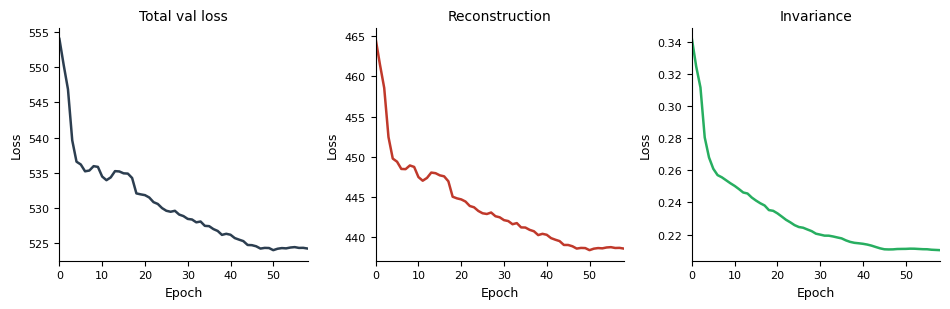
model_A.pl.losses(keys="all")

A.4 — Impute#
return_norm=True adds an area-normalised log1p layer (imputed_norm).
Set area_key=None if your spatial data has no cell_area column.
time_start = time()
dl_A = torch.utils.data.DataLoader(sp_dataset, batch_size=512, shuffle=False)

adata_imputed_A = model_A.impute(
    dl_A,
    obs_adata=sp_adata,
    return_norm=True,
    area_key="cell_area",
    nb_count_samples=20,
    #return_int=True is recomended for denoising data and performing downstream analyses
)
print(f"Imputation time: {(time() - time_start) / 60:.2f} minutes")
print(adata_imputed_A)
Embedding and imputing cells (MC, 50 samples)...
[CellPin.impute] Panel gene order confirmed ✓
  [impute] Filling 1000 gene(s) absent from obs_adata layers with sentinel -2.0
  [impute] Filling 1000 gene(s) absent from obs_adata layers with sentinel -2.0
Imputation time: 1.15 minutes
AnnData object with n_obs × n_vars = 30600 × 1307
    obs: 'cell_id', 'transcript_counts', 'control_probe_counts', 'control_codeword_counts', 'total_counts', 'cell_area', 'nucleus_area', 'region'
    obsm: 'X_cellpin', 'spatial'
    layers: 'counts', 'log1p_norm', 'imputed', 'imputed_norm'
A.5 — Evaluate#
Pearson correlation between observed and imputed counts for panel genes.
print("=== Count space ===")
correlation_panel(adata_imputed_A, layer_real="counts", layer_imputed="imputed")

print("\n=== Log-normalised space ===")
correlation_panel(adata_imputed_A, layer_real="log1p_norm", layer_imputed="imputed_norm")
=== Count space ===
Valid genes (no sentinel): 307
Mean Pearson r           : 0.5938

=== Log-normalised space ===
Valid genes (no sentinel): 307
Mean Pearson r           : 0.4980
A.6 — Visualise#
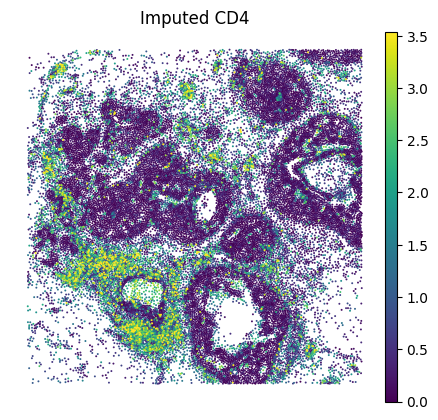
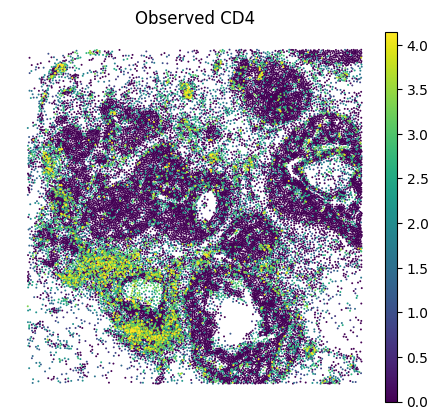
Spatial maps and UMAP for a few marker genes.
MS4A1 and CD19 were in the panel; FCRL1 and PAX5 are purely imputed. (All B cell genes, expected to co-localise)
GENE = "CD4"  # edit as needed

sc.pl.spatial(
    adata_imputed_A, layer="imputed_norm", color=GENE, spot_size=15, vmax="p99", frameon=False, title=f"Imputed {GENE}"
)
sc.pl.spatial(
    adata_imputed_A, layer="log1p_norm", color=GENE, spot_size=15, vmax="p99", frameon=False, title=f"Observed {GENE}"
)
bcells = ["CD19", "MS4A1", "FCRL1", "PAX5"]

print("Spatial plots — B-cell markers:")
sc.pl.spatial(
    adata_imputed_A,
    layer="imputed_norm",
    color=bcells,
    spot_size=15,
    vmax="p99",
    frameon=False,
    title=[f"Imputed {g}" for g in bcells],
)
sc.pl.spatial(
    adata_imputed_A,
    layer="log1p_norm",
    color=bcells,
    spot_size=15,
    vmax="p99",
    frameon=False,
    title=[f"Observed {g}" for g in bcells],
)
Spatial plots — B-cell markers:


A.7 — UMAP from cellpin embeddings#
Cell embeddings in obsm["X_cellpin"] can be used directly to build a neighborhood graph and compute a UMAP
sc.pp.neighbors(adata_imputed_A, use_rep="X_cellpin")
sc.tl.umap(adata_imputed_A)

print("UMAP — B-cell markers:")
sc.pl.umap(adata_imputed_A, color=bcells, layer="imputed_norm", vmax="p99", title=[f"Imputed {g}" for g in bcells],frameon=False)
sc.pl.umap(adata_imputed_A, color=bcells, layer="log1p_norm", vmax="p99", title=[f"Observed {g}" for g in bcells],frameon=False)
UMAP — B-cell markers:


B) Held-Out Gene Evaluation#
To benchmark how well cellpin imputes genes it has never seen during training, we:
Randomly sample a fraction of panel genes as held-out genes
Remove them from the spatial input before
setup_data()Train and impute as normal
Compare imputed values against the ground-truth counts for those held-out genes
The held-out Pearson correlation is the most honest imputation benchmark.
B.1 — Define held-out genes#
rng = np.random.default_rng(42)

# Panel genes in sc_adata order — consistent with setup_data()'s internal ordering
panel_genes_all = [g for g in sc_adata.var_names if g in set(sp_adata.var_names)]
print(f"Full panel size: {len(panel_genes_all)} genes")

HOLDOUT_FRACTION = 0.10  # hold out 10 % of the panel
n_holdout = max(1, int(len(panel_genes_all) * HOLDOUT_FRACTION))
heldout_genes = rng.choice(panel_genes_all, size=n_holdout, replace=False).tolist()
training_genes = [g for g in panel_genes_all if g not in heldout_genes]

print(f"Held-out genes : {n_holdout}  → {heldout_genes[:5]} ...")
print(f"Training panel : {len(training_genes)} genes")
Full panel size: 307 genes
Held-out genes : 30  → ['NDUFA4L2', 'CCDC6', 'LEP', 'CCL8', 'ELF3'] ...
Training panel : 277 genes
# Build the reduced spatial object (held-out genes removed)
sp_adata_reduced = sp_adata[:, training_genes].copy()

assert len(set(heldout_genes) & set(sp_adata_reduced.var_names)) == 0, (
    "Held-out genes still present in reduced sp_adata!"
)
print(
    f"sp_adata_reduced: {sp_adata_reduced.n_obs:,} cells × {sp_adata_reduced.n_vars:,} genes (held-out genes removed ✓)"
)
sp_adata_reduced: 30,600 cells × 277 genes (held-out genes removed ✓)
B.2 — Setup and train#
sc_dataset_B, sp_dataset_B = cellpin.pp.setup_data(sc_adata, sp_adata_reduced, layer=LAYER)
============================================================
[cellpin.pp.setup] Setting up CellPin datasets
============================================================
[cellpin.pp.setup] sc_adata :   23,867 cells  ×    1,307 genes
[cellpin.pp.setup] st_adata :   30,600 cells  ×      277 spatial genes
[cellpin.pp.setup] Expression read from layer='counts'
[cellpin.pp.setup] Panel    : 277 genes overlap (100.0% of spatial genes retained)
[cellpin.pp.setup] Imputed  : 1,307 genes total in sc space (1,030 genes to impute, not in panel)
[cellpin.pp.setup] sc_dataset: 23,867 cells, 1,307 genes total, 277 panel genes
[cellpin.pp.setup] st_dataset: 30,600 cells, 277 panel genes
model_B = cellpin.CellPin(sc_dataset_B)
model_B.fit(
    sc_dataset_B, pretrain_epochs=50, train_epochs=60, save_checkpoints=False
)  # save_checkpoints=True is much slower and not needed for this tutorial
Epoch 0:  39%|███▊      | 29/75 [00:01<00:01, 25.61it/s, v_num=1]
Epoch 49: 100%|██████████| 75/75 [00:03<00:00, 23.22it/s, v_num=1, val_loss=456.0, val_reconst_loss=436.0, val_kl_loss=17.00, val_kl_l_loss=2.390, val_pearson_loss=0.483, train_loss=464.0, train_reconst_loss=444.0, train_kl_loss=17.70, train_kl_l_loss=2.380, train_pearson_loss=0.465]
Epoch 59: 100%|██████████| 75/75 [00:03<00:00, 19.93it/s, v_num=1, val_loss=521.0, val_reconst_loss=436.0, val_kl_loss=55.60, val_kl_l_loss=2.470, val_distill_loss=0.0726, val_snn_loss=1.660, val_inv_loss=0.214, val_snn_temperature=0.104, val_pearson_loss=0.470, train_loss=522.0, train_reconst_loss=436.0, train_kl_loss=59.50, train_kl_l_loss=2.520, train_distill_loss=0.0836, train_snn_loss=1.730, train_inv_loss=0.231, train_snn_temperature=0.104, train_pearson_loss=0.440]
B.3 — Impute#
dl_B = torch.utils.data.DataLoader(sp_dataset_B, batch_size=512, shuffle=False)

adata_imputed_B = model_B.impute(
    dl_B,
    obs_adata=sp_adata_reduced,
    return_norm=True,
    area_key="cell_area",
    nb_count_samples=20,
    #return_int=True is recomended for denoising data and performing downstream analyses
)
print(adata_imputed_B)
Embedding and imputing cells (MC, 50 samples)...
[CellPin.impute] Panel gene order confirmed ✓
  [impute] Filling 1030 gene(s) absent from obs_adata layers with sentinel -2.0
  [impute] Filling 1030 gene(s) absent from obs_adata layers with sentinel -2.0
AnnData object with n_obs × n_vars = 30600 × 1307
    obs: 'cell_id', 'transcript_counts', 'control_probe_counts', 'control_codeword_counts', 'total_counts', 'cell_area', 'nucleus_area', 'region'
    obsm: 'X_cellpin', 'spatial'
    layers: 'counts', 'log1p_norm', 'imputed', 'imputed_norm'
B.4 — Evaluate#
Two metrics:
Panel Pearson — reconstruction quality on the training genes (sanity check)
Held-out Pearson — true imputation benchmark on genes the model never saw
print("=== Training panel genes (count space) ===")
correlation_panel(adata_imputed_B, layer_real="counts", layer_imputed="imputed")
=== Training panel genes (count space) ===
Valid genes (no sentinel): 277
Mean Pearson r           : 0.5963
print("=== Held-out genes — count space ===")
correlation_heldout(
    adata_imputed_B,
    sp_adata_full=sp_adata,  # sp_adata (full) has ground-truth counts for held-out genes
    heldout_genes=heldout_genes,
    layer_real="counts",
    layer_imputed="imputed",
)
=== Held-out genes — count space ===
  NDUFA4L2              Pearson = 0.1975
  CCDC6                 Pearson = 0.6173
  LEP                   Pearson = 0.3429
  CCL8                  Pearson = 0.1985
  ELF3                  Pearson = 0.6551
  ENAH                  Pearson = 0.4506
  TIMP4                 Pearson = 0.2919
  KRT14                 Pearson = 0.8070
  ITGAX                 Pearson = 0.7537
  LYZ                   Pearson = 0.7676
  GNLY                  Pearson = 0.5750
  CX3CR1                Pearson = 0.4900
  SPIB                  Pearson = 0.3898
  CXCL12                Pearson = 0.8441
  KRT23                 Pearson = 0.8277
  DNAAF1                Pearson = 0.0584
  AGR3                  Pearson = 0.6253
  FOXA1                 Pearson = 0.8592
  FOXP3                 Pearson = 0.3508
  PTN                   Pearson = 0.7818
  PDCD1LG2              Pearson = 0.2287
  CCND1                 Pearson = 0.7912
  SQLE                  Pearson = 0.4533
  ANKRD30A              Pearson = 0.8562
  SERPINA3              Pearson = 0.7612
  CEACAM8               Pearson = -0.0366
  GPR183                Pearson = 0.5304
  CLECL1                Pearson = 0.2589
  LILRA4                Pearson = 0.7407
  CCPG1                 Pearson = 0.4594

Mean Pearson over 30 held-out genes: 0.5309
print("=== Held-out genes — log-normalised space ===")
correlation_heldout(
    adata_imputed_B,
    sp_adata_full=sp_adata,
    heldout_genes=heldout_genes,
    layer_real="log1p_norm",
    layer_imputed="imputed_norm",
)
=== Held-out genes — log-normalised space ===
  NDUFA4L2              Pearson = 0.1717
  CCDC6                 Pearson = 0.5261
  LEP                   Pearson = 0.1451
  CCL8                  Pearson = 0.1529
  ELF3                  Pearson = 0.6506
  ENAH                  Pearson = 0.3184
  TIMP4                 Pearson = 0.0974
  KRT14                 Pearson = 0.7578
  ITGAX                 Pearson = 0.5899
  LYZ                   Pearson = 0.6539
  GNLY                  Pearson = 0.3986
  CX3CR1                Pearson = 0.4187
  SPIB                  Pearson = 0.3675
  CXCL12                Pearson = 0.7626
  KRT23                 Pearson = 0.7281
  DNAAF1                Pearson = 0.0097
  AGR3                  Pearson = 0.5790
  FOXA1                 Pearson = 0.8434
  FOXP3                 Pearson = 0.3118
  PTN                   Pearson = 0.7032
  PDCD1LG2              Pearson = 0.1542
  CCND1                 Pearson = 0.6785
  SQLE                  Pearson = 0.3021
  ANKRD30A              Pearson = 0.8321
  SERPINA3              Pearson = 0.6422
  CEACAM8               Pearson = -0.0062
  GPR183                Pearson = 0.5405
  CLECL1                Pearson = 0.2273
  LILRA4                Pearson = 0.5649
  CCPG1                 Pearson = 0.2203

Mean Pearson over 30 held-out genes: 0.4448
B.5 — Visualise held-out genes#
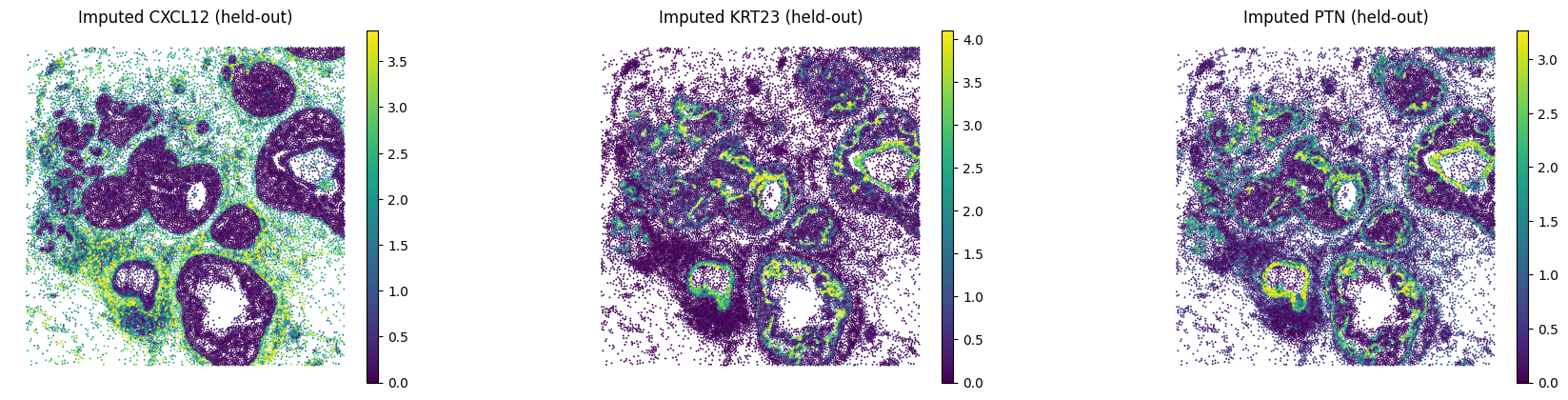
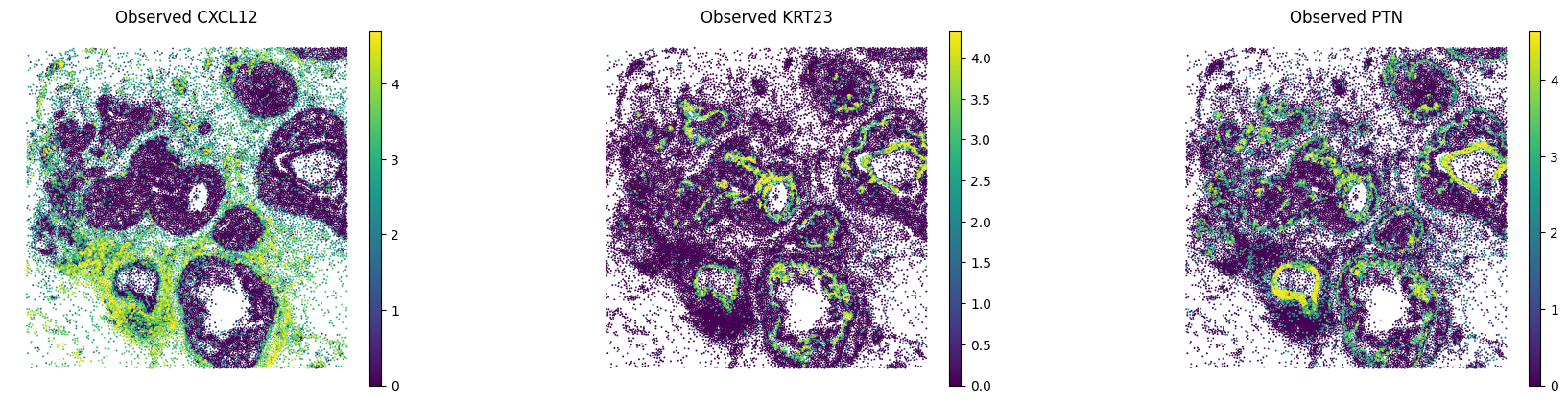
Compare imputed vs. observed spatial expression for a few held-out genes with strong Pearson correlation.
# Edit: pick held-out genes with high Pearson from the evaluation above
GENES_HELDOUT = ["CXCL12", "KRT23", "PTN"]

sc.pl.spatial(
    adata_imputed_B,
    layer="imputed_norm",
    color=GENES_HELDOUT,
    spot_size=15,
    vmax="p99",
    frameon=False,
    title=[f"Imputed {g} (held-out)" for g in GENES_HELDOUT],
)
sc.pl.spatial(
    sp_adata,
    layer="log1p_norm",
    color=GENES_HELDOUT,
    spot_size=15,
    vmax="p99",
    frameon=False,
    title=[f"Observed {g}" for g in GENES_HELDOUT],
)